Regardless of any political conservatism, King Kalakaua, last reigning king of the Kingdom of Hawai‘i, seems to have left his mark in ways that matter—dancing, storytelling, surfing and music! He revived hula and surfing; his support of the ukulele contributed to its becoming the musical instrument symbolic of Hawaii; he wrote the lyrics to Hawai‘i Pono‘i, which became the Hawaiian state song. Not long after his reign began, in an attempt to boost a struggling economy, he negotiated a treaty with President Ulysses S Grant which allowed certain Hawaiian goods to be admitted to the United States tax-free. I don’t know if ‘fancy sliced’ pineapple was part of the deal, but this old packaging box features him prominently. It goes without saying that I like the typography, but I especially like his portrait—or is that Magnum, PI?
Beach weather
The torrential Sydney rain has finally stopped and it’s looking more like beach weather. If ever I need to know the weather forecast, experience has proved that the most reliable method is to call my friend in Geelong. Whatever weather she is experiencing on that particular day is the weather we will have in Sydney the next. It’s uncannily accurate—more so than conventional weather reports. Regardless, I’m in an airconditioned office today so will not be needing the suntan lotion, and no, that’s not her in the picture.
Letraset
Although Letraset is the name of a UK-based company that has been making products for the graphic design industry since 1959, the word ‘letraset’ (at least to designers) has joined the ranks of hoover, thermos, dry ice, cellophane, escalator, videotape, velcro, astroturf, esky, biro, bubble wrap, hills hoist, hula hoop and google—by acquiring generic word status. Whoever says ‘I’m going to apply a dry-transfer rubdown using a purpose-made burnishing tool and this sheet of Helvetica 24pt decals’! Although actually, in this digital age of desktop publishing, not many people would letraset it either. Letrasetting is deceptive in the level of skill required to execute it well. I have evidence of this—a record cover I designed early in my career has a slightly crooked R in the title, which jumps out at me accusingly every time I see it.
Tree
I don’t know how we function without labelling everything! More so, I am also amazed at how a simple word can impart so much information—this hinged metal square set in concrete is obviously not a tree, but it conveys much about inner city landscape planning and management in relation to the tree close by. And I quite like that speckled pink terrazzo.
Encyclopaedia Britannica
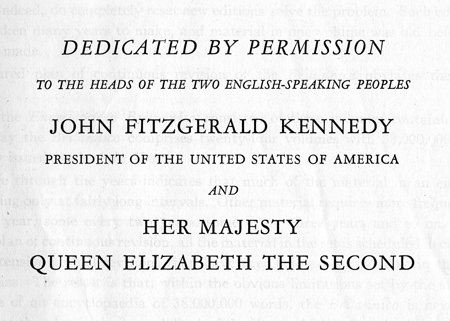
Encyclopaedia Britannica was founded in 1768 and the first edition was published as three volumes. The last printed edition was published in 2010, and it had grown to 32 volumes, 32 640 pages, with almost 4500 contributors (including Nobel prize winners and American presidents) and about 100 editors. When I was quite young my family procured a set of encyclopedias, bought second-hand from I don’t know where, an already well-used 14th edition 24-volume set published in 1962. I used it often and with great enjoyment (they were books after all!) but once I finished school those stuffy pages held little interest for me. Until recently, that is, when my family wanted to get rid of it, and I thought it would make excellent fodder for book art re-purposing. To my surprise I am finding that it holds almost more interest now than it did then. The publisher was William Benton—a Minnesota-born (on 1 April 1900, how wonderful!), Yale-educated, Connecticut senator—and Harry S Ashmore, the editor-in-chief, was a Pulitzer prize winner. The departmental editors and advisors is a staggeringly impressive list of highly educated people, and as I flick through the pages of Volume 1 (A to Annoy) I find information about Absolute Pitch, Aero Engines, Alaska, Amarillo, Andromeda and Anhydride—with a sense of discovery and surprise that doesn’t come from looking stuff up on Wikipedia. No doubt these volumes will end up reconfigured, cut up, folded, papier mached, rebound and restructured, but perhaps I will enjoy them for a while longer as the books they are. And perhaps I will keep this dedication page.
Christmas trees
Corrugated iron is one of those materials that lends itself to a multitude of uses. And like rust, so many people like it! My roof is made of corrugated iron (fortunately without any accompanying rust), and when it rains I can barely hear myself think, and I have a pet dog called Lulu made of corrugated iron (she not only has some rust, but some peeling off paint too!). On a recent visit to the south coast I came upon these corrugated iron christmas trees adorning the fence of a christmas tree farm.
Happy holidays
DF Celebrations was designed in 1994 by Canadian designer and illustrator James Wilson. The collection of woodcut-like dingbats contains a range of festive images for any occasion, including christmas day. Of course there’s nothing to illustrate an Australian christmas, which typically involves the beach, barbecues and prawns! Happy day, wherever you are and whatever you do.
Ho ho ho!
It’s the season of cheer alright. Christmas carols in parks, colourful banners in main streets, tinsel and baubles in christmas trees. And christmas sales already! In general, the obvious signs of commercial christmas don’t seem to be as blatantly overdone as some years, but what I have seen is a staggeringly high incidence of unimaginative typography. There are thousands and thousands and thousands of typefaces out there—many of them free—but it is as if the only fonts that can be used in the lead up to christmas are Algerian, Comic Sans and Papyrus.
Tree of birds
This year I went to the Auburn cherry blossom festival for the first time. I suppose it was pretty naive of me, but I thought I was only in for a display of cherry blossoms. I did indeed get that, and they were spectacular, but what I hadn’t accounted for was the hordes of people being shuttle-bussed in, the extensive cultural program, the amazing sight of cosplayers and kimono wearers, and the prepared-for-everything picnickers. Unfortunately I missed the haiku workshop, but I did get to see this impressive tree of origami birds.
Cafe
This cafe, in Goulburn, is not the famous Paragon, but an unassuming place a block down the road. The Paragon used to be a regular stop on any Sydney–Melbourne drive (in the days before the bypass) because they served such a great burger. These days I am intimidated by the Paragon. It’s been renovated and glitzed up to within an inch of its life, all bright lights and so much shiny chrome on the outside that I’m too scared to set foot inside to confirm my suspicion that the lovely old laminex booths have gone the way of the once-understated shopfront.

![kinghawaii[c]alphabetcitypress](https://alphabetcitypress.com/wp-content/uploads/2016/01/kinghawaii.gif?w=525)
![beachbabe[c]alphabetcitypress](https://alphabetcitypress.com/wp-content/uploads/2016/01/beachbabe.gif?w=525)
![letrasetgill[c]alphabetcitypress](https://alphabetcitypress.com/wp-content/uploads/2016/01/letrasetgill.gif?w=525)
![tree[c]alphabetcitypress](https://alphabetcitypress.com/wp-content/uploads/2016/01/tree.gif?w=525)
![corrytrees[c]alphabetcitypress](https://alphabetcitypress.com/wp-content/uploads/2015/12/corrytrees.gif?w=525)
![celebrations[c]alphabetcitypress](https://alphabetcitypress.com/wp-content/uploads/2015/12/celebrations.gif?w=525)
![nonono[c]alphabetcitypress](https://alphabetcitypress.com/wp-content/uploads/2015/12/nonono.gif?w=525)
![origamibirds[c]alphabetcitypress](https://alphabetcitypress.com/wp-content/uploads/2015/12/origamibirds.gif?w=525)
![ycafe[c]alphabetcitypress](https://alphabetcitypress.com/wp-content/uploads/2015/12/ycafe.gif?w=525)