Steinway

steinwayK[c]alphabetcitypress

Steinway & Sons, maker of high quality, award-winning pianos, was founded in New York in 1853 by German immigrant Heinrich Engelhard Steinweg, who later changed his name to Henry E Steinway. By 2000, they had made more than 550,000 pianos, each of which takes almost a year to complete. In 2010, on John Lennon’s 70th birthday anniversary, Steinway introduced a series of limited edition pianos based on the white grand piano Lennon owned. More than 1600 artists—including Duke Ellington, Cole Porter, Daniel Barenboim and George Gershwin—have the title Steinway Artist, which means they have chosen to perform exclusively on Steinway pianos. Not only are Steinways notable for their sound quality, but their logo is instantly recognisable. It was designed by William Steinway and the current design was first used in 1955. I have noticed the typography of the logo before, with the S shapes and ampersand, but what brings it to my attention now is seeing Diana Krall, a Steinway Artist of course, play her set last night on the Sydney Opera House piano, logo in gold on the side facing the audience.

19

19[c]alphabetcitypress

The number 19 by itself would be noteworthy but its surroundings give it an added dimension. There is such attention to detail in the ornate framing and duotone brickwork. The left hand side of the facade had matching brickwork and a corresponding framed AD, but I liked this side better because of the way it abuts the concrete pillar of the neighbouring building. On a dull day it would most likely look completely different but the blue sky and clear light make the concrete appear architecturally dramatic.

Giacometti Pi

giacomettigreen[c]alphabetcitypress

I was not happy with the idea that a digital font, especially a Lintotype font, could disappear: given the ever-expanding nature of the digital universe it seemed counter-intuitive. So, spurred along by an email from my friend, I discovered that, instead of disappearing, Giacometti has expanded. GiacomettiLL has become Giacometti Pi and is now accompanied by Giacometti Letter, with an impressive 425-strong character set that includes fractions and symbols. The fonts were designed by German illustrator Sine Bergmann, who also designed Linotype Festtagsfont (more stick figures, this time with a festive theme, as the name suggests), and Jump (with Leonore Poth), an informal handwritten script.

GiacomettiLL

giacomettiblue[c]alphabetcitypress

Something unusual happened today. I googled the font GiacomettiLL in order to learn something about its provenance and came up with zilch. I found one reference to it but the link took me to a different font, albeit one with almost the same name—to plain old Giacometti, without the LL, which is a font with the usual character set. GiacomettiLL is a dingbat font with stick-like figures drawn in the style of Alberto Giacometti’s spindly sculptures. Alberto Giacometti, born in 1901, was a Swiss sculptor and printmaker who is best known for his tall, stick-figure, bronze sculptures, so the font is well-named.

Red crossing

redxing[c]alphabetcitypress

Pedestrian crossings are not usually red. This one wasn’t on a particularly dangerous corner and visibility was good in both directions, but it was certainly eye-catching — not only because it is brightly coloured (luminous even in the greyness of a cloudy day) but because it is weathered and patchy in that most fabulous abstract expressionist way. My experience of photographing it was interesting: in the city, no one would have taken the slightest bit of notice of me (let alone given way to me, a pedestrian), but in the small town where this crossing is located, every driver stopped to let me cross, and I had to keep waving them on.

Ice

ice[c]alphabetcitypress

I’m pretty certain the letters POL are missing from the left hand side of this window work of art, but the vacant and run-down building gave no other tangible clues to indicate whether it was once the police station in reality or just in my imagination. I like the gaffer tape covering a crack in the glass, the cobwebs and the imperfections and reflections, and I particularly like the drawn embellishments around the letters — the white sort-of-outline and the blue sort-of-shadow — and that the pane of glass really does look like it has been frozen.

Today’s stall

gardenclub[c]alphabetcitypress

Here’s a work of art and it comes ready framed! A rich story could be constructed from the elements presented here: a garden club, a raffle, a butcher’s shop, what did Trish and Carol win, and why are the chairs being returned to Taylor’s? The chalk-drawn handwriting displays the running writing style that was taught in Australian schools in a certain era, and the background patina of many-times-rubbed-out chalk holds the social history of a community.

PMN Caecilia

pmncaecilia9c0alphabetcitypress

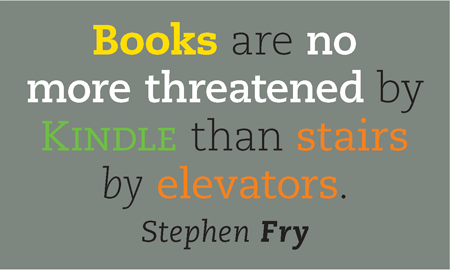
PMN Caecilia is a humanist slab serif typeface designed by Peter Matthias Noordzu and released by Linotype in 1990. The typeface has low-contrast stroke weights and an even texture, large x-height, open counters and unbracketed serifs, all features that make it easy to read. The family contains a large range of weights — light, roman, bold, heavy, oldstyle — and an extensive character set. The friendliness and readability of PMN Caecilia make it an excellent font for use in childrens’ and educational publishing, and it is the font of choice for the Kindle.

Shoes

shoes[c]alphabetcitypress

There was nothing special about the shoe shop, but the illustration on the awning brought a touch of lightness to an overcast sultry afternoon. This row of feet is so expressive! Here they are, lined up and ready to step out to the local dance hall to shake a leg, tango and two-step, jitterbug and charleston, jive and mambo. What I like most is how a small touch like this speaks volumes: the illustration itself imparts personality, but more importantly, someone has paid attention to detail, and as a result the everyday is enhanced.

Miller

miller[c]alphabetcitypress

Miller is a transitional serif typeface, designed by Matthew Carter, based on typefaces cut by Richard Austin in the Scottish type foundries of Alexander Wilson and William Miller in the early 19th century. Miller was released by the Font Bureau in 1997, and what started as a family of seven fonts has grown to more than 37. The general purpose weights, Miller Text and Miller Display, have been joined by a range of variants developed by Carter with the assistance of Tobias Frere-Jones and Cyrus Highsmith. They include Miller Daily, Miller News, Bibliographical Miller, Miller Headline and Miller Banner. A relatively large x-height makes Miller an excellent typeface for use in newspapers, and can be seen in The Guardian, The Washington Post, The Boston Globe, The Dallas Morning News, the San Jose Mercury News, to name a few.