Perpetua was designed by Eric Gill in 1928 for Stanley Morison, typographic advisor for Monotype Corporation. Morison had a twofold plan for the growth of the Monotype library: the first stage was to develop modern interpretations of classic designs for machine composition; and the second stage was to develop new designs, which is where Gill came in. The design and release of Perpetua was fraught with complications. Gill was openly disdainful of mechanical devices (which included the Monotype typesetter), and Monotype’s management was conservative, and hostile towards Morison’s ideas. Then the project was put on hold because it was considered that a new sans serif design was more urgent than a new book face. Perpetua was finally released more than seven years after Gill was first commissioned to start work on it.
Duc de Berry
Duc de Berry was designed by Gottfried Pott as part of the 1990 program, Type before Gutenberg, which included the work of twelve contemporary font designers and represented styles from across the ages. It is named after the Duke of Berry, aka John the Magnificent, a collector of illuminated manuscripts and other works of art he commissioned, such as the Très Riches Heures du Duc de Berry, one of the best surviving examples of French Gothic manuscript illumination. Duc de Berry is influenced by French blackletter traditions but has more open counters and curvilinear strokes. The distinguishing flourishes and hairline strokes of the capital letters give them an elegance which makes them suitable for use as initials, and when set as text it is more readable than other blackletter typefaces.
Drive on left
I’m usually more interested in the shapes and patterns of letter forms than the substance of the message, but this road sign, on the way to Tidal River in Wilsons Promontory, certainly caught my eye. It imparts more information than a mere driving directive: it implies that the road is frequented by motorists accustomed to driving on the right, which in turn means it’s a pretty popular tourist destination for international travellers, and that those drivers could well be new to driving on the left—hardly surprising when only about ten per cent of the world’s total road distance carries left-hand traffic. In Australia the decision to follow the British practice of driving on the left was made in the early nineteenth century by Governor Lachlan Macquarie. One thing Australian road signs have in common with right-hand drive countries is the typeface, which derives from the alphabet drawn for the US Federal Highway Administration in 1949—so while this sign looks like Interstate (it’s a dead ringer for Interstate Regular Condensed) it isn’t, because Interstate came later. Interstate, a family of 40 fonts designed by Tobias Frere-Jones in the early 1990s, was based on that original alphabet, but the digitised version has refinements that make it suitable for printed text.
ITC Berkeley Oldstyle
ITC Berkeley Oldstyle is a revival of University of California Old Style, a typeface designed in 1938 by Frederic W Goudy exclusively for the University of California Press at Berkeley. In 1983 Tony Stan was commissioned by ITC to work on the revised version, and ITC Berkeley Oldstyle was released in 1983. ITC Berkeley Oldstyle features elongated ascenders and descenders, a calligraphic weight stress, smooth weight transitions and a fairly generous x-height—features which result in excellent character legibility. It is one of my typefaces of choice when I’m designing text-heavy books: its lightness and clarity make swathes of text less intimidating without any loss of gravitas. The italic weight is one of the most legible serif italics there is, and I particularly like the angled horizontal stroke of the lower case e.
Valentines
February 14, Valentine’s Day, was first associated with romantic love in Geoffrey Chaucer’s time, when, in 1382, he wrote (translated): For this was on St Valentine’s Day, when every bird cometh there to choose his mate. So the custom of giving flowers, chocolates and greeting cards—known as valentines—evolved in England, and goes back centuries, although in modern times handwritten valentines are less common than mass-produced greeting cards. In the UK an estimated 25 million cards are sent each year, and in the US the figure is a staggering 190 million. When you take into account the valentines that are made in school activities, that number increases to 1 billion. And that’s not counting e-valentines. In the area of book arts there are bookbinding structures that lend themselves extremely well to expressing matters of the heart—something as simple as folding two leaves of a book into the spine creates a heart shape. In typography, Zapf Dingbats contains three widely recognisable heart shapes, although I can’t recall every having the need to use the sideways one.
GiacomettiLL
Something unusual happened today. I googled the font GiacomettiLL in order to learn something about its provenance and came up with zilch. I found one reference to it but the link took me to a different font, albeit one with almost the same name—to plain old Giacometti, without the LL, which is a font with the usual character set. GiacomettiLL is a dingbat font with stick-like figures drawn in the style of Alberto Giacometti’s spindly sculptures. Alberto Giacometti, born in 1901, was a Swiss sculptor and printmaker who is best known for his tall, stick-figure, bronze sculptures, so the font is well-named.
PMN Caecilia
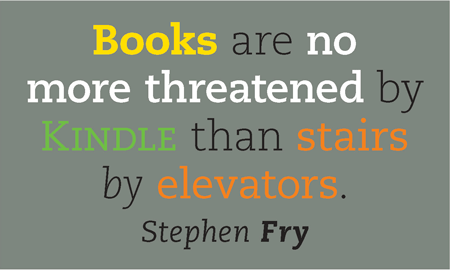
PMN Caecilia is a humanist slab serif typeface designed by Peter Matthias Noordzu and released by Linotype in 1990. The typeface has low-contrast stroke weights and an even texture, large x-height, open counters and unbracketed serifs, all features that make it easy to read. The family contains a large range of weights — light, roman, bold, heavy, oldstyle — and an extensive character set. The friendliness and readability of PMN Caecilia make it an excellent font for use in childrens’ and educational publishing, and it is the font of choice for the Kindle.
Miller
Miller is a transitional serif typeface, designed by Matthew Carter, based on typefaces cut by Richard Austin in the Scottish type foundries of Alexander Wilson and William Miller in the early 19th century. Miller was released by the Font Bureau in 1997, and what started as a family of seven fonts has grown to more than 37. The general purpose weights, Miller Text and Miller Display, have been joined by a range of variants developed by Carter with the assistance of Tobias Frere-Jones and Cyrus Highsmith. They include Miller Daily, Miller News, Bibliographical Miller, Miller Headline and Miller Banner. A relatively large x-height makes Miller an excellent typeface for use in newspapers, and can be seen in The Guardian, The Washington Post, The Boston Globe, The Dallas Morning News, the San Jose Mercury News, to name a few.
Post here
There’s not much time left to get your letter to Santa. These days you can submit an online letter and get an instant reply, but that’s just not the same as pen and paper. Australia Post provides instructions whichever way you want to do it, including how to address the envelope (North Pole, postcode 9999, plus, wouldn’t you know it, a 60 cent stamp), and if you live in Australia they promise they will reply. In the United States, USPS has been officially involved with Santa mail since 1912, when Postmaster General Frank Hitchcock authorised postal employees to reply to the letters. In New York, ‘Operation Santa’ responds to more than half a million letters each year. You could post your Santa letter here, in this red pillar box that has been in use in NSW for more than a hundred years. The hinge is showing some wear and tear but the instruction is as clear as ever. Although the typeface looks very much like Trade Gothic, it isn’t: Trade Gothic was designed in 1948, years after this postbox was made. Amazingly, if Australia Post imposed its current sans serif font of choice, Univers, over this century old type style, it wouldn’t look very different.
Night noises
It was noisy last night. The crickets and cicadas, noisy all day, were joined by frogs around dusk. At 9 pm, right on time, the thunk! on the kitchen roof, followed by another thunk! a few minutes later, signalled the arrival of possums at the party. DF Wildlife, designed by David Sagorski for Letraset in 1994, is a collection of all sorts of creatures — insects, reptiles, birds, mammals, dinosaurs — but unfortunately I couldn’t find a cicada (the loudest and most relentless of last night’s menagerie) in the character set. However there is a mosquito, another visitor that featured large in the middle of the night.

![perpetua[c]alphabetcitypress](https://alphabetcitypress.com/wp-content/uploads/2014/06/perpetua.gif?w=525)
![ducdeberry[c]alphabetcitypress](https://alphabetcitypress.com/wp-content/uploads/2014/03/ducdeberry.gif?w=525)
![driveleft[c]alphabetcitypress](https://alphabetcitypress.com/wp-content/uploads/2014/03/driveleft.gif?w=525)
![berkeley[c]alphabetcitypress](https://alphabetcitypress.com/wp-content/uploads/2014/02/berkeley.gif?w=525)
![hearts[c]alphabetcitypress](https://alphabetcitypress.com/wp-content/uploads/2014/02/hearts.gif?w=525)
![giacomettiblue[c]alphabetcitypress](https://alphabetcitypress.com/wp-content/uploads/2014/01/giacomettiblue.gif?w=525)

![miller[c]alphabetcitypress](https://alphabetcitypress.com/wp-content/uploads/2014/01/miller.gif?w=525)
![posthere[c]alphabetcitypress](https://alphabetcitypress.com/wp-content/uploads/2013/12/posthere.gif?w=525)
![nightnoise[c]alphabetcitypress](https://alphabetcitypress.com/wp-content/uploads/2013/12/nightnoise.gif?w=525)