Reflection

reflection[c]alphabetcitypress

They say it never rains but it pours, and although it’s a phrase not necessarily intended to describe actual weather, it certainly applies to the pattern of rainfall in Sydney. Two days ago I planted a small shrub to fill a hole in a garden that is suffering extreme dryness, and within a few hours it started bucketing down so heavily that I couldn’t hear myself think for the sound of rain on the tin roof. It has been relentless, and now everything is damp and soggy. I love the rain, and I love the way it transforms the world around me so that transitory patterns emerge, like this stand of lights reflected in a puddle on tarmac.

Quality

quality[c]alphabetcitypress

You never see butchers touting themselves as ordinary or run-of-the-mill. Prime cuts, superior grade, blue-ribbon, choice, select, A1 and quality are the usual descriptors. This butcher is Armidale is no exception. The lettering is confident, friendly and inviting, reassuring shoppers that quality is not intimidating or likely to break the bank.

Google

googlemockup[c]alphabetcitypress

Earlier this week the Google logo underwent an adjustment. The bottom of the l and e didn’t quite line up, so to fix it, the g was moved one pixel to the right and the l was moved one pixel down and to the right. The change is almost imperceptible—much more subtle than my rough mock-up shows—but the spacing was altered to allow the logo to appear more evenly positioned on small screens. Despite the fact that Google didn’t publicise the change it seems to have received an inordinate amount of publicity! The current Google logo has been in use since September 2013 and was designed by Ruth Kedar. It utilises the font Catull, an oldstyle serif designed for the Berthold Type Foundry in 1982 by Gustav Jaeger.

The letter E

letterE[c]alphabetcitypress

The letter E is the fifth letter and second vowel in the Latin alphabet, and is by far the most commonly used letter, not only in English, but in many other languages, including French, German, Spanish, Czech, Danish and Norwegian. Over time, the direction of reading E has changed. The Phoenician letter HE represented a man with arms raised to the sky. The Etruscans turned it anticlockwise so the stem was on the right, then it was turned again to become the present-day E, with the stem on the left. E represents about fifteen sounds (here, there, everywhere and more!) and has many symbolic meanings—Energy, East, Ecstasy, electron, a musical note, and more recently, e for electronic.

Happy hens

twochooks[c]alphabetcitypress

These magnificent birds loom large on the roadside about half way between Geelong and Ballarat, overseeing the entrance to a free-range egg farm. The egg farm prides itself on its humane practices and healthy birds, and if the chooks are anywhere near as jolly as their giant metal guardians appear to be, then they are happy chooks indeed. The surrounding landscape is scrubby and flat, which makes the metal sculptures—there are three of them—an even more arresting sight to behold.

Carrots

carrots[c]alphabetcitypress

I used to think that carrots were orange, but it seems that orange carrots are a relative newcomer to the vegetable scene. The first cultivated carrots were purple and yellow, followed by white and red varieties. The orange carrot became popular in the Netherlands several hundred years later—according to one story, it was a mutant, bred to honour the Dutch House of Orange. I was thrilled to discover that there is an online carrot museum, which, as well as the history and recipes you might expect, features carrot collectibles, carrot artwork and—my favourite­—musical instruments made from carrots. When my friends and I drove through Bannockburn, Victoria, a couple of weeks ago, we stopped at a farmers market and saw this colourful array, and bought some for dinner.

Very far

veryfar[c]alphabetcitypress

It was a drizzly grey Sunday. We weren’t the only ones who thought pizza and beer sounded like a good idea, and although the car park wasn’t completely full, we did have to park in the ‘very far’ area. Helvetica can be badly used and overused, but it can also be a well-chosen and appropriate typeface. Here, Helvetica Bold Condensed is condensed more, letter-spaced, and treated to complement the timber boards on which it is painted. The letter shapes retain excellent legibility even when manipulated, and needless to say, we had no trouble finding the car when it was time to go home.

Warning

unattended[c]alphabetcitypress

This is not the sort of warning you see every day. The novelty of the message caught my attention and tickled my funny bone, but the same words printed more formally in, say, Franklin Gothic or Times New Roman, would change the tone completely. Handwritten in chalk, framed with uneven knocked together old timber, and the serious message that parents need to watch their kids in the play area is delivered in exceedingly good spirit. The message is not the full picture though: the choice of blackboard and frame is obviously well thought out to fit in with a design aesthetic, as is the placement on the background of scarred and scrawled-on brickwork which has been left in its original state.

Apartments

apartments[c]alphabetcitypress

There’s a shop in Queenscliff, Victoria, that has an enticing walk-through entrance full of overgrown plants in aged moss-covered terracotta pots. It’s the kind of courtyard garden I would love to be able to cultivate, but lack the particular type of green thumb that allows selective neglect to metamorphose into a harmonious, established mess of leaves. The courtyard walls are covered in ivy that has extended around the corner to take over this apartment block, transforming the very ordinary bricks and signage. I particularly like the way the letters appear to be emerging from their camouflage.

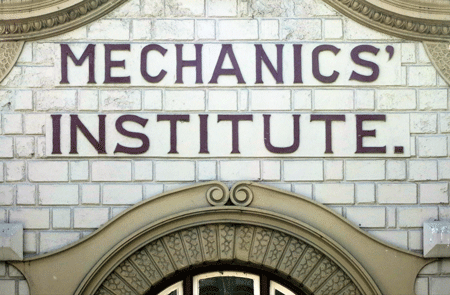
Mechanics’ institute

mechanics

Mechanics’ Institutes, established in Scotland in 1821, were formed to provide education in technical subjects to working men. They also housed libraries which aimed to provide an alternative pastime to gambling and drinking. The first Australian Mechanics’ Institute opened in Hobart in 1827, followed by the Sydney Mechanics’ School of Arts in 1833. In Victoria, more than 1200 Mechanics’ Institutes were built, including this one in Leongatha, which operated until 1982 and played an important role in the development of the local community. The building itself, containing a Public Reading Room, Members’ Room and Billiard Room, is notable for the construction of the walls, which are made from river weeds covered in plaster, a technique unique to the area. Also notable is the sign, the individual letters full of life and character.